

How Much Money Did The Federal Government Make 2017
Federal Funds Hover at a Third of State Revenue
Notation: This data has been updated. To run across the almost recent data and analysis, visit Fiscal 50.
The share of states' revenue fabricated upward by federal dollars held steady at roughly i-tertiary in fiscal year 2022, with nearly equal numbers of states posting upticks and drops in the percentage of their money coming from federal funds. Overall, the U.S. government provided 32.iv percent of all the acquirement nerveless by states in fiscal yr 2022—down slightly from 32.six percent a year earlier.
A slim majority of states—26—saw declines in the share of their revenue coming from federal dollars in fiscal 2022, including states that accepted too as states that did non accept federal coin to expand eligibility for Medicaid health intendance coverage. Still, federal funds were at their quaternary-highest level in more than 50 years as a percentage of 50-country revenue, based on data going back to 1961, underscoring the significant part that federal dollars play in financing state government.
Nationwide, states collected an additional $17 billion, or ii.8 percent more, in federal dollars than a year earlier amid a slowdown in the catamenia of wellness care grants—the largest portion of federal aid to states. Information technology was the smallest increase since a grouping of states first began receiving extra Medicaid funding in 2022 later opting to cover newly eligible low-income adults under the Affordable Intendance Deed (ACA). While federal funds rose, full country revenue—including taxes and other sources, such as public academy tuition, tolls, and lottery receipts—increased in fiscal 2022 at a greater rate: 3.two percent.
Fiscal 2022 marked the outset time that the 31 states with expanded Medicaid coverage then in consequence had to pick upwardly five pct of the costs of insuring enrollees who became eligible nether the ACA, though it was just for the second one-half of the financial twelvemonth, which ends in June for about states. Nether the Medicaid provisions in the ACA, the federal government from January 2022 to December 2022 reimbursed states for all costs incurred by the expansion population. States gradually will become responsible for x percent of those costs by Jan. ane, 2022. The federal government'due south reduced share of Medicaid expansion costs combined with slower growth in overall Medicaid enrollment likely contributed to the slowdown in federal health care grants to states.
The federal share of state revenue reflects how much funding states receive from the federal regime to aid pay for public services such equally health care, education and training, transportation, and other infrastructure. (Run into "Federal Spending Decisions Bear on Land Budgets.") The indicator measures the combined effects of swings in state and federal funds. Changes in either revenue source touch the ratio of federal to full dollars. A higher or lower pct does not necessarily indicate a trouble for state budgets.
Download the data
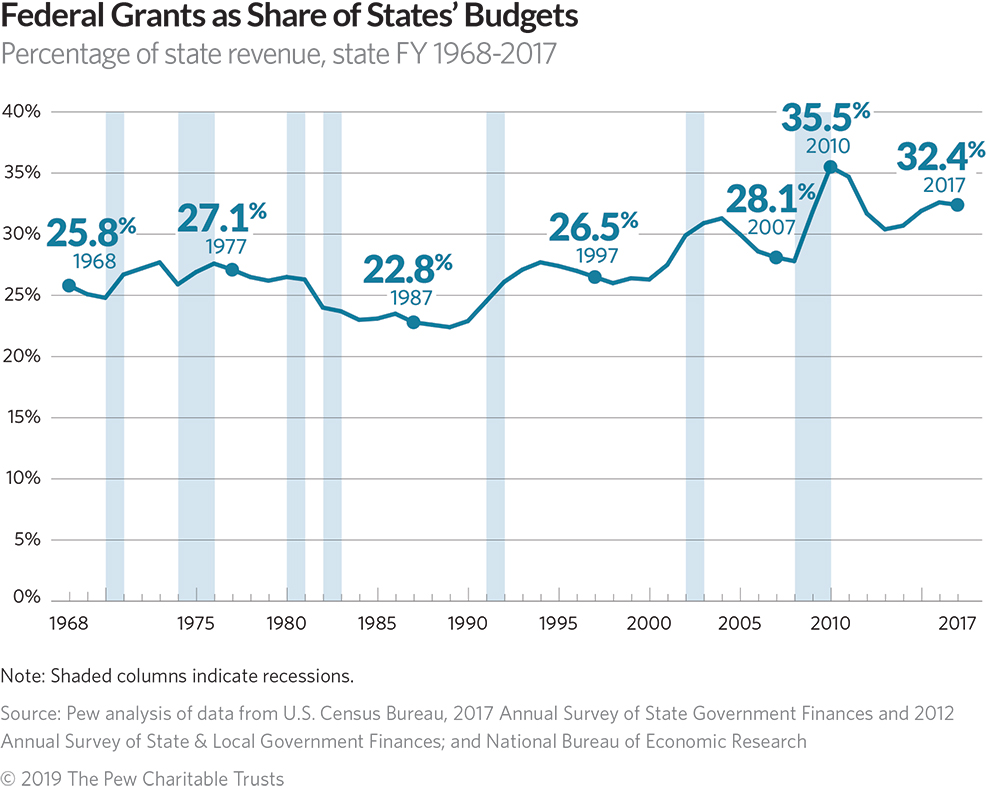
Historically, the federal share of fifty-state revenue has ranged from virtually one-quarter to one-tertiary. The highest shares occurred just afterward the Great Recession, when a temporary influx of federal economic stimulus dollars and falling state tax acquirement caused the federal share of states' revenue to reach 35.5 percent in financial 2022 and 34.7 per centum in fiscal 2022. The 3rd-highest share was in fiscal 2022, largely because of growth in Medicaid grants to states. Medicaid accounts for about 2-thirds of federal grants to states.
The role of federal dollars in country finances has been expanding. The financial 2022 share of 32.four per centum was 2.2 per centum points higher than the 20-year average of xxx.2 percent since 1998, and more than 7 pct points greater than the 25 percent average from 1978 to 1997, based on rounded information.
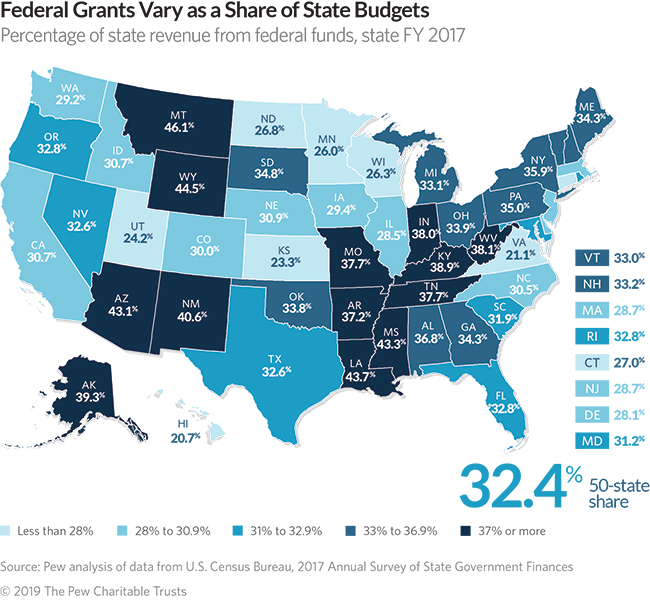
Land highlights
Federal shares vary across the state. Fiscal 2022 data show:
- Montana reported the highest percentage of state revenue from federal funds (46.1 percent), taking the meridian spot for the start time since the tardily 1980s in its offset full twelvemonth of Medicaid expansion.
- In add-on to Montana, the pct of state revenue from federal funds was roughly twice every bit swell in Wyoming (44.5), Louisiana (43.vii), Mississippi (43.3), and Arizona (43.1)—the states where federal shares were highest—as in Hawaii (20.vii percentage), Virginia (21.ane), and Kansas (23.three), the states where the shares were everyman.
- Federal funds accounted for the largest revenue source—rather than state tax dollars—in vii states: Alaska, Arizona, Louisiana, Mississippi, Montana, New United mexican states, and Wyoming.
- 5 states received their highest share of revenue from federal funds on record: Montana (46.ane per centum), Indiana (38.0), Arkansas (37.2), Pennsylvania (35.0), and Delaware (28.1). Just one country received its lowest share: Utah (24.2).
- In fiscal 2022, Wyoming had the biggest percentage-point gain in the federal share of state revenue, up 6.4 points from the previous year. The country had a spike in mineral leasing of public lands. The land with the steepest decline—of 2.8 percentage points—was Oregon, where federal funds fell half a percentage point while own-source revenue had the second-highest almanac growth charge per unit across united states.
- Compared with their xx-year averages through fiscal 2022, just xiv states received a smaller pct of their revenue from the federal government. The biggest difference was in Kansas. The federal share of its revenue averaged 27.4 percent over the past twenty years but was 4.2 percentage points below that level in fiscal 2022. The next-biggest decreases were in S Dakota (iii.8 per centum points), Utah (3.ii), and N Dakota and Hawaii (2.3).
- Of the 36 states that received a greater portion of their acquirement from the federal regime in 2022 than their 20-year averages, Alaska had the largest increase: fourteen pct points. In recent years, its revenue has tumbled as weak energy prices hit taxation collections in the article-dependent country. The next-biggest increases were in Nevada (9.four points), Arizona (8.7), and Indiana (8.0).
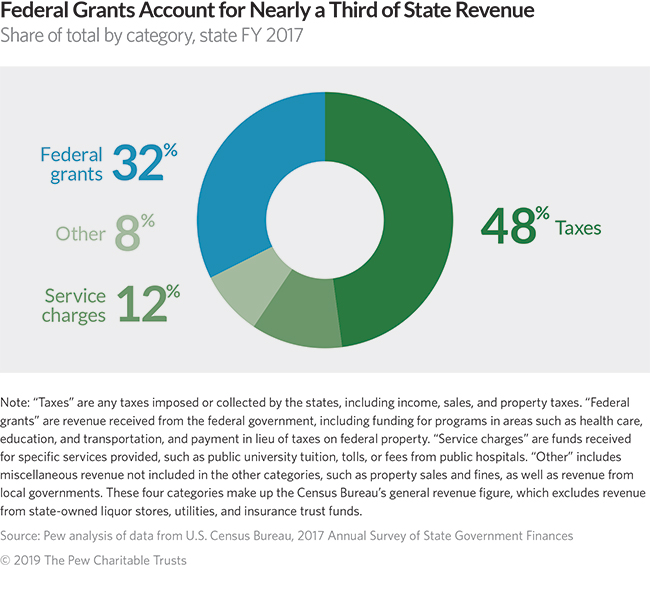
Federal dollars remained the second-largest source of states' acquirement in fiscal 2022, bookkeeping for almost $639 billion, or about a third of the $1.97 trillion collected by country governments. Tax collections are states' leading revenue generator and reached $943 billion in fiscal 2022, or nearly half of state revenue.
Download the data to see individual country trends. Visit Pew's interactive resources Fiscal 50: Country Trends and Analysis to sort and analyze information for other indicators of state fiscal health.
ADDITIONAL Resource
MORE FROM PEW

Source: https://www.pewtrusts.org/en/research-and-analysis/articles/2019/10/08/federal-funds-hover-at-a-third-of-state-revenue
Posted by: godwindrome1960.blogspot.com
0 Response to "How Much Money Did The Federal Government Make 2017"
Post a Comment