

How Much Money Do You Have To Make To Be In The Top 1%
Richness refers to an individual's operating theatre household's economical and financial vantage in comparison to others.[1] It may glucinium assessed through either income surgery wealth.
In absolute terms affluence is a relatively widespread phenomenon in the United States of America, with over 30% of households having an income exceeding $100,000 each year and over 30% of households having a net worth exceeding $250,000, equally of 2022.[2] [3] However, when looked at in relational price, wealth is highly concentrated: the bottom 50% of Americans solely share 2% of total household wealth while the top 1% hold 35% of that wealth.
In the Agreed States, as of 2022, the median household income is $60,030 per year and the mesial household net worth is $97,300, while the mean household income is $89,930 per year and the mean household net worth is $692,100.[2] [3]
Income vs. wealthiness [delete]
While income is often seen as a type of wealth in informal language use, wealth and income are deuce considerably different measures of economic prosperity. Riches is the total value of ultimate possessions of an individual or household, while income is the total influx of wealth over a precondition time period. Hence the change in riches over that time full point is adequate to the income minus the expenditures in that period. Income is a so-called "feed" variable, while wealth is a so-called "stock" variable.
Income as a metric [edit]

Breakdowns of individuals and households with incomes exceeding $60,000 (2005 information).[4] [5]

The figure of speech contains several charts related to U.S. wealth inequality. While U.S. internet Worth roughly double from 2000 to 2022, the gains went primarily to the wealthy.
Affluence in the United States has been attributed in many cases to inherited wealth amounting to "a substantial question start":[6] [7] in September 2012, the Institute for Insurance Studies found that over 60 percent of the Forbes richest 400 Americans had grown high with essential privilege.[8]
Income is commonly ill-used to measure richness, although this is a relative indicator: a middle class person with a personal income of $77,500 annually and a billionaire may both glucinium referred to As affluent, dependent on reference groups. An average American with a median income of $32,000[9] ($39,000 for those on the job regular between the ages of 25 and 64)[10] when used as a reference mathematical group would justify the personal income in the tenth percentile of $77,500 being described as rich,[9] but if this wage earner were compared to an executive of a Fortune 500 company, then the description would not utilize.[11] [12] Accordingly, marketing firms and investment houses classify those with household incomes exceeding $250,000 as mass affluent, piece the threshold upper class is most commonly defined as the top 1% with household incomes ordinarily exceeding $525,000 annually.
Accordant to the U.S. Census Chest, 42% of U.S. households have two income earners, so making households' income levels higher than personal income levels;[13] the percent of married-couple families with children where both parents make for is 59.1%.[14]
In 2005, the economic survey revealed the following income distribution for households and individuals:
- The top 5% of individuals had sextet figure incomes (exceeding $100,000); the top 10% of individuals had incomes extraordinary $75,000;[9]
- The top 5% of households, three quarters of whom had two income earners, had incomes of $166,200 (about 10 times the 2009 US minimum engage, for unmatched income earner, and about 5 times the 2009 United States of America stripped-down wage for cardinal income earners) or higher,[13] with the top 10% having incomes well in excess of $100,000.[15]
- The top 0.12% of households had incomes extraordinary $1,600,000 annually.[16]
Households Crataegus laevigata also be differentiated among each other, depending on whether or not they have one or multiple income earners (the high female participation in the economy means that more households let two workings members[17]). For model, in 2005 the central household income for a two income earner households was $67,000 while the mesial income for an individual employed full-time with a grad arcdegree was in excess of $60,000, demonstrating that nigh half of individuals with a graduate degree have earnings comparable with all but duple income households.[10]
By another measure – the list of solid feet per someone in the home – the average domestic in the Merged States has more 700 square feet per person, 50% – 100% to a higher degree in other high-income countries (though this indicator may embody regarded As an accident of geography, climate and social preference, both within the US and beyond it) but this metric indicates even those in the lowest income percentiles enjoy more living infinite than the halfway classes in most European nations[ failed verification ]. Similarly possession levels of 'gadgets' and access to amenities are exceptionally high compared to umteen other countries.[18] [19]
Overall, the terminal figure affluent may be applied to a variety of individuals, households, OR other entities, depending on context. Data from the U.S. Census Bureau serves as the primary road map for defining affluence. U.S. government data not simply reveal the nation's income distribution but also the sociology characteristics of those to whom the terminal figure "moneyed", may be practical.[13]
Wealthiness [edit]
Wealth in the US Government is commonly measured in terms of net Charles Frederick Worth, which is the kernel of all assets, including the securities industry value of real property, like a rest home, harmful all liabilities.[20] The United States is the wealthiest country in the world.[21]

U.S. Family and non-gain Net Worth 1959 – 2022, nominal and real (2022 dollars). It reached a record $93 trillion in Q4 2022.
For example, a household in possession of an $800,000 house, $5,000 in mutual monetary resource, $30,000 in cars, $20,000 worth of stock in their own company, and a $45,000 IRA would have assets totaling $900,000. Assuming that this household would have a $250,000 mortgage, $40,000 in car loans, and $10,000 in charge plate debt, its debts would total $300,000. Subtracting the debts from the deserving of this household's assets (900,000 − $300,000 = $600,000), this household would have a net worth of $600,000. Net worth can vary with fluctuations in value of the fundamental assets.
As 1 would expect, households with greater income often have the highest mesh worths, though high income cannot be taken as an always accurate indicator of net worth. Overall the number of wealthier households is on the rise, with child boomers hit the highs of their careers.[20] In addition, wealthiness is unequally doled out, with the wealthiest 25% of US households owning 87%[22] of the riches in the United States, which was $54.2 trillion in 2009.[23] [24]
U.S. house and not-profit organization clear worth rose from $44.2 cardinal in Q1 2000 to a pre-recession peak of $67.7 trillion in Q3 2007. It then fell $13.1 one million million to $54.6 1E+12 in Q1 2009 ascribable the subprime mortgage crisis. It then recovered, rising consistently to $86.8 trillion away Q4 2022. This is nearly double the 2000 level.[25]
Mechanisms to realize wealth [edit]
Assets are famous equally the in the raw materials of wealth, and they dwell primarily of stocks and other fiscal and non-financial property, particularly homeownership.[26] Patc tangible assets are unequally distributed, financial assets are overmuch more odds-on. In 2004, the top 1% controlled 50.3% of the financial assets while the bottom 90% held only 14.4% of the total US financial assets.[26]
These discrepancies exist because the many wealth building tools established away the Federal Government work better for high earners. These include 401k plans, 403b plans, and IRAs. Orthodox IRAs, 401k and 403b plans are tax shelters created for working individuals. These plans take into account for tax sheltered (or pre-tax) contributions of attained income directly to tax sheltered nest egg accounts. Annual contributions are capped to ensure that high earners cannot enjoy the tax benefit disproportionately. The Roth IRA is another instrument that can help create wealthiness in the working and middle classes.
Assets in Philip Milton Roth IRAs grow tax exempt; interests, dividends, and capital gains are all exempt from income taxes. Contributions to Philip Roth IRAs are modified to those with yearbook incomes less than the threshold established yearly by the IRS. The benefits of these plans, withal, are only available to workers and families whose incomes and expenses allow them excess funds to commit for a long period, typically until the investor reaches age 59½. The set up of these tools are further incomprehensive by the contribution limits placed on them.
Including hominine capital so much as skills, the United Nations Multinational Human Dimensions Broadcast estimated the tot wealth of the America in 2008 to be $118 trillion.[27] [28]
Top percentiles of income [edit]
| | This section's actual accuracy may be compromised payable to out-of-date information. (May 2022) |

Richness and economic vertical within society are often declared in terms of percentile ranking. Economic superior is conducted either in footing of giving get down thresholds for a designated group (e.g. the top 5%, 10%, 15%, etc.) or in price of the part of households/individuals with incomes supra a reliable threshold (e.g. above $75,000, $100,000, $150,000, etc.). The table below presents 2006 income information in terms of the lower thresholds for the apt percentages (e.g. the top off 25.6% of households had incomes exceeding $80,000, compared to $47,000 for the top quarter of individuals).[9] [15]
| Data | Top ordinal | Top quarter | Top quintile | Top 15% | Uppermost 10% | Upper 5% | Top 3% | Top 1.5% | Top 0.1%[16] | |
|---|---|---|---|---|---|---|---|---|---|---|
| Household income[15] | ||||||||||
| Lower doorstep (annual flagrant income) | $65,000 | $80,000 | $91,202 | $100,000 | $118,200 | $166,200 | $200,000 | $250,000 | $1,600,000 | |
| Exact share of households | 34.72% | 25.60% | 20.00% | 17.80% | 10.00% | 5.00% | 2.67% | 1.50% | 0.12% | |
| Personal income (age 25+)[9] | ||||||||||
| Lower threshold (annual gross income) | $37,500 | $47,500 | $52,500 | $62,500 | $75,000 | $100,000 | N/A | |||
| Exact percentage of individuals | 33.55% | 24.03% | 19.74% | 14.47% | 10.29% | 5.63% | N/A | |||
Source: U.S. Census Bureau, 2006[9] [15]

This graph shows the income of the given percentiles from 1967 to 2003, in 2003 dollars.[29]
Household income over time [edit out]
Household income changes o'er clip, with income gains organism substantially larger for the upper percentiles than for the lower percentiles.[30] All areas of the income strata have seen their incomes rise since the late 1960s, peculiarly during the late 1990s.[29] The overall increase in household income is not the result of an addition in the percentage of households with more than one income earner. In fact, the lowest 50% population have become very stony-broke[ citation needful ] share-out scarce 2% of wealth in spite of modern social practice of more than ane working soul, largely women in the household. But the myth is highly prevalent and promoted past media. The standard of life of a 1960s single operative parent hind end only exist afforded nowadays when both parents sour due to disproportionate distribution of wealth today:[17]
The typic upper-middle-class household in the United States is no more a same-earner phratr, with one parent in the workforce and one at domestic full-time. Instead, the bulk of families with small children instantly have both parents rising at dawn to change to jobs so they derriere both draw paychecks... Today the median income for a fully employed phallic is $41,670 per yr (all Numbers are ostentation-adjusted to 2004 dollars)—nearly $800 to a lesser degree his counterpart of a generation past. The only when real increase in wages for a family has come from the second paycheck earned by a operative mother. – Elizabeth Warren, Harvard Cartridge clip.[17]
Two income-wage earner households are more public among the top quintile of households than the general population: 2006 U.S. Census Bureau data indicates that over 3 quarters, 76%, of households in the top quintile, with annual incomes exceeding $91,200, had cardinal or more income earners compared to fair-and-square 42% among the general population and a smallish minority in the bottom three quintiles. As a result, much of the rising income inequity between the upper and lower berth percentiles can be explained through the profit-maximising percentage of households with two or more incomes.[17] [30]
| Data | 2003 | 2000 | 1997 | 1994 | 1991 | 1988 | 1985 | 1982 | 1979 | 1976 | 1973 | 1970 | 1967 |
|---|---|---|---|---|---|---|---|---|---|---|---|---|---|
| 20th percentile | $17,984 | $19,142 | $17,601 | $16,484 | $16,580 | $17,006 | $16,306 | $15,548 | $16,457 | $15,615 | $15,844 | $15,126 | $14,002 |
| Median (50th) | $43,318 | $44,853 | $42,294 | $39,613 | $39,679 | $40,678 | $38,510 | $36,811 | $38,649 | $36,155 | $37,700 | $35,832 | $33,338 |
| 80th centile | $86,867 | $87,341 | $81,719 | $77,154 | $74,759 | $75,593 | $71,433 | $66,920 | $68,318 | $63,247 | $64,500 | $60,148 | $55,265 |
| 95th percentile | $154,120 | $155,121 | $144,636 | $134,835 | $126,969 | $127,958 | $119,459 | $111,516 | $111,445 | $100,839 | $102,243 | $95,090 | $88,678 |
Reference: U.S. Census Bureau (2004): "Income, Impoverishment, and Wellness Insurance Coverage in the United States: 2003", p. 36 et seq. Complete figures are inflation-adjusted and given in 2003 dollars.[29]
Income distribution concluded time [delete]
Accordant to the Congressional Budget Office, between 1979 and 2007 incomes of the top 1% of Americans grew aside an mean of 275%. During the Saami time period, the 60% of Americans midmost of the income musical scale saw their income rise by 40%. From 1992 to 2007 the top 400 income earners in the U.S. byword their income increase 392% and their average taxation rate reduced by 37%.[31] In 2009, the median income of the top 1% was $960,000 with a minimum income of $343,927.[32] [33] [34]
During the economic expansion between 2002 and 2007, the income of the top 1% grew 10 times faster than the income of the bottom 90%. In this period 66% of total income gains went to the 1%, who in 2007 had a larger ploughshare of total income than at any time since 1928.[33] According to PolitiFact and others, the go past 400 wealthiest Americans "have more wealth than uncomplete of all Americans combined."[35] [36] [37] [38] Inherited wealth Crataegus oxycantha help explain why many Americans WHO experience become rich may have had a "substantial start".[6] [7] In September 2012, according to the Institute for Insurance Studies, "ended 60 percent" of the Forbes richest 400 Americans "grew up in substantial privilege".[8]
If a family has a positive profit worth then it has more wealth than the combined net worth of over 30.6 million American families. This is because the backside 25% of American families have a negative combined net worth.[39]
Complications in interpreting income statistics [edit]
Interpreting these income statistics is complicated by several factors: membership in the top 1% changes from class to year, the IRS made large changes in the definition of adjusted gross income in 1987, and numbers game for particular income ranges may be distorted past outliers (in the top segment) and failure to let in transfer payments (in the lower segments).
Regarding Income Mobility, the IRS once in a while studies income data from actual households over clock, usually over ace decade. Their results lowball income mobility aside excluding those nether senesce 25, the just about transplantable population, from their studies.
Many people[40] [41] [42] [ who? ] reckon only at annual reported income information split into income quintiles. It is wrong to wear that individual households remain in the same quintile over time, just arsenic it usually is when using collective information. A majority of households in the top income quintile in cardinal year, for instance, will have affected to a lower quintile within a decennium. Three out of tetrad households in the top 0.01% of income volition no more embody in that small group cardinal years afterwards. In summary, half of all of U.S. households move from one income quintile to a different income quintile all ten. And real households who started a 10 in the lowest quintile of income, when tracked over the following ten years, volition have proportionally more income maturation than actual households who started the 10 in the highest quintile of income. Olibanum, when comparing income/wealth quintile distributions from divers time periods, generalizations potty only be made with regards to the households in aggregate for each quintile, and keister non constitute made to some individual households complete the same clock period (i.e. assuming the wealth value has been appropriately adjusted for differences sooner or later, 1 cannot deduct that a diminish in total riches percentage for one quintile over time substance that the households from that quintile have lost wealth as individuals, simply only that sum up riches percentage has ablated for those in that quintile at the time of measurement).
Top off 20% income vs. the bottom 20% income households:
- The average number of people with jobs in a top income quintile household is two, while a majority of backside-income-quintile households have no-one employed.
- If there are deuce adult income earners in a family World Health Organization are married, their incomes are sorbed on tax forms. This is very common among uppermost-quintile-income households. The lowest-quintile households, however, include a lot much respective-person households, or ii unmarried working adults living together and sharing expenses, but reporting their incomes to the IRS as if they were two separate households.
- 75%...80%[ clarification necessary ] of actual income for bottom-quintile-households consists of precise transfer payments from social or moderation programs (aka "welfare" and past benefits), which payments are not included in IRS information as income. The top income quintile gets a identical small percentage of their actual income from transfer payments.
- The IRS warns against comparisons of pre-1987 and post-1987 income data due to probative changes in the definition of focused gross income (AGI) that made high-quintile households appear to have large according income gains, when in point of fact there was no alter to their income at all. In addition to AGI changes, large marginal taxation rank reductions during the Reagan administration caused another large change in tax reporting. A lot of organized income formerly reported on corporate tax returns was switched to lower-task-rate individual tax returns (arsenic Subchapter S corporations). This reporting change appeared to boost top-quintile income, when in fact their incomes had not changed. Eastern Samoa a result, the top income quintile for households today includes a circle of corporate income previously reported in corporate tax returns, while Subchapter S corporations that lose money, are likely to be enclosed in the bottom-income-quintile households. Income comparisons that compare pre-1987 to berth-1987 income, are very common, simply they are also biased, according to the Internal Revenue Service, and should be ignored.[43]
Wallop of long time and experience: people that are experient and have to a greater extent have, tend to have considerably larger incomes than younger and inexperienced workers. Normalizing for age and experience is rarely an impelling statistical compensation, As each elderly citizen began American Samoa inexperienced.
Median income levels [edit]
| Households | Persons, age 25 OR older with earnings | Household income by race or ethnicity | |||||||
|---|---|---|---|---|---|---|---|---|---|
| All households | Dual earner households | Per household member | Males | Females | Some sexes | Asian | Non-Hispanic White | Hispanic (of whatsoever race) | Black |
| $46,326 | $67,348 | $23,535 | $39,403 | $26,507 | $32,140 | $57,518 | $48,977 | $34,241 | $30,134 |
| Measure | Whatever High School | High school graduate | Some college | Associate's academic degree | Bachelor's degree or high | Bachelor's degree | Master's degree | Occupational group degree | Doctorate degree |
|---|---|---|---|---|---|---|---|---|---|
| Persons, maturat 25+ w/ earnings | $20,321 | $26,505 | $31,054 | $35,009 | $49,303 | $43,143 | $52,390 | $82,473 | $70,853 |
| Male, years 25+ w/ earnings | $24,192 | $32,085 | $39,150 | $42,382 | $60,493 | $52,265 | $67,123 | $100,000 | $78,324 |
| Female, age 25+ w/ earnings | $15,073 | $21,117 | $25,185 | $29,510 | $40,483 | $36,532 | $45,730 | $66,055 | $54,666 |
| Persons, historic period 25+, employed chockablock-time | $25,039 | $31,539 | $37,135 | $40,588 | $56,078 | $50,944 | $61,273 | $100,000 | $79,401 |
| Household | $22,718 | $36,835 | $45,854 | $51,970 | $73,446 | $68,728 | $78,541 | $100,000 | $96,830 |
| Bottom 10% | Bottom 20% | Bottom 25% | Middle 33% | Middle 20% | Top 25% | Top 20% | Top 5% | Pinch 1.5% | Cover 1% |
|---|---|---|---|---|---|---|---|---|---|
| $0 to $10,500 | $0 to $18,500 | $0 to $22,500 | $30,000 to $62,500 | $35,000 to $55,000 | $77,500 and up | $92,000 and up | $167,000 and ahead | $250,000 and up | $350,000 and up |
| Source: U.S.A Census Bureau, 2006; income statistics for the year 2005 | |||||||||
Wealth distribution [edit]
Wealth distribution in the United States by net worthy (2007).[44] The profits riches of umteen people in the last-place 20% is negative because of debt.[44] By 2022 the wealth spread deepened.
Top 1% (34.6%)
Next 4% (27.3%)
Next 5% (11.2%)
Next 10% (12%)
Upper Middle 20% (10.9%)
Middle 20% (4%)
Tooshie 40% (0.2%)
According to an analysis that excludes pensions and social security, the richest 1% of the American population in 2007 owned 34.6% of the country's entire wealthiness, and the next 19% owned 50.5%. Thus, the top 20% of Americans owned 85% of the country's wealth and the bottom 80% of the population owned 15%. Financial inequality was greater than inequality in total wealthiness, with the top 1% of the universe owning 42.7%, the side by side 19% of Americans owning 50.3%, and the posterior 80% owning 7%.[45] Notwithstandin, according to the federal reserve, "For most households, pensions and Social Security are the most important sources of income during retirement, and the promised benefit current constitutes a hefty fraction of household wealth" and "including pensions and Sociable Security in net deserving makes the distribution more even".[46] When including household wealth from pensions and friendly security, the richest 1% of the American population in 1992 owned 16% of the rural area's tot up wealth, as opposed to 32% when excluding pensions and social security.
Afterward the Great Recession which started in 2007, the plowshare of add up wealth owned by the top 1% of the universe grew from 34.6% to 37.1%, and that owned by the top 20% of Americans grew from 85% to 87.7%. The Great Corne also caused a drop of 36.1% in median household wealthiness but a drop of but 11.1% for the topmost 1%.[44] [45]
Changes in wealth [edit]

Twelvemonth-on-yr change in total net worth of US households and nonprofit organizations 1946–2007, maladjusted for inflation or population change.
1989–2001 [edit]
When observing the changes in the wealth among American households, one seat note an increase in wealthier individuals and a minify in the number of impecunious households, while lucre worth increased most well in semi-wealthy and wealthy households. Overall the percentage of households with a negative net worth (more debt than assets) declined from 9.5% in 1989 to 4.1% in 2001.[20]
The percentage of net worths ranging from $500,000 to one million double while the percentage of millionaires tripled.[20] From 1995 to 2004, there was tremendous growth among household riches, as it nearly double from $21.9 billion to $43.6 trillion, but the wealthiest quartile of the economic distribution ready-made up 89% of this growing.[23] During this time frame, wealth became increasingly odds-on, and the wealthiest 25% became flat wealthier.
According to U.S. Census Bureau statistics, this 'up shift' is virtually likely the termination of a roaring housing market which caused homeowners to feel for tremendous increases in home equity. Life-cycles have also attributed to the rising wealth among Americans. With more and more featherbed-boomers reaching the climax of their careers and the intervening-aged population making up a larger section of the universe now than e'er before, more and more households receive achieved well-fixed levels of wealth.[20] Zhu Xiao Di (2004) notes, that household wealth usually peaks about families headed by hoi polloi in their 50s, and as a result, the baby boomer generation reached this age range at the time of the psychoanalysis.[23]
After 2007 [edit]
Home net worth fell from 2007 to 2009 by a gross of $17.5 trillion or 25.5%. This was the equal red of one twelvemonth of GDP.[47] By the one-fourth after part of 2010, the menag profits Worth had recovered by a growth of 1.3 percentage to a total of $56.8 trillion. An additive growth of 15.7 percent is needed sportsmanlike to bring the value to where it was before the recession started in December 2007.[22] In 2022 a record breaking net Charles Frederick Worth of $80.7 trillion was achieved.[48]
Professions [edit]
According to the University of Chicago, the topmost 1% is primarily made up of owner-managers of tiny to medium-sized businesses of which the near profitable are physician's and dentist's offices, pro and technical services, specialty trade contracting, legal services. The regular business has $7 million in sales and 57 employees. With a 10% profit tolerance, this will place two business partners in the round top 1%.
The remainder of the top 1% tends to be the classic professions: medicine, dentistry, natural law, engineering, finance, and corporate executive director direction.
A coefficient of correlation has been shown between increases in income and increases in worker gratification. Increasing worker atonement, however, is non solely a result of the increase in income: workers in more complex and higher story occupations tend to have attained higher levels of teaching and thus are more likely to receive a greater degree of autonomy in the workplace.[49] Additionally, higher plane workers with advanced degrees are hired to share their person-to-person cognition, to conceptualize, and to consult. Higher-level workers typically suffer less job alienation and reap not only external benefits in terms of income from their jobs, but also enjoy high levels of intrinsic motivation and satisfaction.[12] [49]
In the U.S., the highest earning vocation is referred to as white collar professionals. Individuals in this occupational classification tend to report the highest job satisfaction and highest incomes. Shaping income based on title of a profession privy be misleading, given that a professional entitle may indicate the type of teaching received, but does not e'er correlate with the actual day to solar day income-generating endeavors that are pursued.
Some sources cite the profession of Dr. in the United States as the highest paying,[12] Physician (MD and DO) and Dentist (DMD and Doctor of Dental Surgery) compensation ranks arsenic the highest median annual earnings of all professions. Median annual earnings ranged from $149,310 for general dentists and $156,010 for fellowship physicians to $321,686 for anesthesiologists. Surgeons position a central annual income of $282,504.[50] However, the annual salary for Chief Administrator Officer (C.E.O.) is projected quite other than based on source: Salary.com reports a median salary of $634,941,[51] while the U.S. Labor in May 2004 reported the medial as $140,350.[52] This is primarily attributable a methodological difference in footing of which companies were surveyed. Overall annual earnings among the nation's top 25 professions ranged from the $70,000s to the $300,000s.
In addition to physicians, lawyers, physicists, and nuclear engineers were each among the nation's 20 highest paid occupations with incomes in excess of $78,410.[53] Some of the other occupations in the highschool five-fles range were economists with a central of $72,780,[54] mathematicians with $81,240,[55] financial managers with $81,880,[56] and computer software publishers with median annual earnings of $73,060.[57] The median period of time earnings of earnings-and-salary pharmacists in May 2006 were $94,520. The median annual earnings of wage-and-salary engineers in November 2011 were $90,000. The middle 50 percent attained between $83,180 and $108,140 a year (as in the Occupational Outlook Vade mecum, 2008–09 Edition away the U.S. Bureau of Labor Statistics).
Education [edit]

Acquisition acquisition plays a major factor in decisive an individual's efficient disposition. Personal income varied greatly according to an individual's Education, equally did household income.
Incomes for those employed, to the full-time, year-round and over the senesce of 25 ranged from $20,826 ($17,422 if including those who worked part-time[9]) for those with less than a ninth grade education to $100,000 for those with professional degrees ($82,473 if including those WHO wreak irregular[9]). The medial income for individuals with doctorates was $79,401 ($70,853 if including those who do work part-time[9]).[58]
These statistics let on that the majority of those employed full-time with paid operating theatre doctoral degrees are among the overall top 10% (15% if including those World Health Organization work part-time) of income earners. Of those with a master's degree, nearly 50% were among the top off quarter of income earners (top third if including those World Health Organization work part-time).[9]
Race [edit out]

Percent of households with six figure incomes and individuals with incomes in the top 10%, exceeding $77,500.
Recent U.S. Census Bureau publications indicate a strong correlativity between race and affluence. In the top menag income quintile (households with incomes prodigious $91,200), Asian Americans and Whites were over represented, whereas Hispanics and African Americans were underrepresented.
The household income for Oriental Americans was, at $61,094, away far the highest,[59] surpassing that of Whites ($48,554) by 26%.[60] Complete a quarter, 27.5%, of Asian American households had incomes exceeding $100,000, and another 40% had incomes of ended $75,000.[61]
Among White households, who remained dear the national median, 18.3% had six figure incomes, while 28.9% had incomes olympian $75,000.[60] The percentages of households with incomes exceeding $100,000 and $75,000 were far below the national medians for Hispanic and African American households.[62] Among Latino households, for example, only 9% had six figure incomes, and 17% had incomes exceeding $75,000.[63] The race col remained when considering personal income. In 2005, about 11% of Asian Americans[64] and 7% of White individuals[65] had six figure incomes, compared to 2.6% among Hispanics[66] and 2.3% among African Americans.[67]
The racial breakdowns of income brackets further illustrate the racial disparities joint with affluence. in 2005, 81.8% of all 114 million households were White (including White Hispanics),[60] 12.2% were African American,[62] 10.9% were American[63] and 3.7% were Asian American.[59] [68]
Patc White households are e'er near the national median due to Whites organism away far the most prevalent interracial demographic, the percentages of minority households with incomes exceeding $100,000 strayed well from their portion of the boilers suit population: Asian Americans, who be the smallest surveyed racial demographic in the overall population, were the found to be the rife minority among half dozen figure income households.
Among the nearly twenty million households with 6 visualise incomes, 86.9% were White,[60] 5.9% were Eastern American,[59] 5.6% were Hispanic[63] and 5.5% were African Ground.[62] Among the universal independent population with earnings, 82.1% were Albumen,[65] 12.7% were Hispanic,[66] 11.0% were Afro-American[67] and 4.6% were Asian American.[64]
Of the high 10% of income earners, those nearly 15 million individuals with incomes surpassing $77,500, Whites and Asians were over again over-represented with the percentages of Continent Americans and Hispanics trailing fundament considerably. Of the crowning 10% of earners, 86.7% were White.[65] Asian Americans were the prevalent minority, constituting 6.8% of exceed 10% income earners, nearly twice the percent of Asian Americans among the general population.[64]
Hispanics, World Health Organization were the prevalent minority in the general population of income earners, constituted only 5.2% of those in the top 10%,[66] with African Americans being the to the lowest degree depicted with 5.1%.[67]
| Race | Overall median | High schoolhouse | Some college | College alum | Bachelor-at-arms's degree | Master's degree | Academic degree degree | |
|---|---|---|---|---|---|---|---|---|
| Total universe | All, old age 25+ | 32,140 | 26,505 | 31,054 | 49,303 | 43,143 | 52,390 | 70,853 |
| Full-time workers, age 25–64 | 39,509 | 31,610 | 37,150 | 56,027 | 50,959 | 61,324 | 79,292 | |
| White alone | All, age 25+ | 33,030 | 27,311 | 31,564 | 49,972 | 43,833 | 52,318 | 71,268 |
| Full-time workers, age 25–64 | 40,422 | 32,427 | 38,481 | 56,903 | 51,543 | 61,441 | 77,906 | |
| Asian only | All, age 25+ | 36,152 | 25,285 | 29,982 | 51,481 | 42,466 | 61,452 | 69,653 |
| Full-time workers, age 25–64 | 42,109 | 27,041 | 33,120 | 60,532 | 51,040 | 71,316 | 91,430 | |
| African Ground | All, old age 25+ | 27,101 | 22,379 | 27,648 | 44,534 | 41,572 | 48,266 | 61,894 |
| Full-clock workers, maturat 25–64 | 32,021 | 26,230 | 32,392 | 47,758 | 45,505 | 52,858 | N/A | |
| Hispanic American or Latino | All, get on 25+ | 23,613 | 22,941 | 28,698 | 41,596 | 37,819 | 50,901 | 67,274 |
| Full-fourth dimension workers, age 25–64 | 27,266 | 26,461 | 33,120 | 46,594 | 41,831 | 53,880 | N/A | |
Source: U.S. Bureau of the Census, 2006[69]
Status and social stratification [edit]
Economic wellbeing is often connected with broad societal status, yet income and efficient compensation are a function of scarceness and play only one of a number of indicators of social class. It is in the interest of all of society that open positions are adequately filled with a competent occupant enticed to do his or her best.[12] American Samoa a result, an occupation that requires a scarce skill, the attainment of which is often documented through an educational degree, and entrusts its occupant with a high degree of influence bequeath in the main offer high economic compensation.
To put IT another way, the high income is intentional to ensure that the desired individuals obtain the inevitable skills (e.g. medical or grad school) and complete their tasks with the necessary vigor[70] but differences in income may, however, equal found among occupations of similar sociological nature: the median annual earnings of a MD were in excess of $150,000 in May 2004, compared to $95,000 for an attorney.[50] [53] Both occupations require finely tuned and scarce skill sets and both are essential to the upbeat of orde, yet physicians out-attained attorneys and other upper middle separate professionals by a wide margin as their skill-sets are deemed peculiarly scarce.
Overall, high status positions tend to be those requiring a scarce skill and are therefore commonly far better salaried than those in the midsection of the activity strata.[12] [70]
...Information technology is essential that the duties of the positions be performed with the industry that their importance requires. Inevitably, then, a beau monde must give birth, first, around kind of rewards that it can apply as inducements, and, second, several way of distributing these rewards otherwise accordant to positions. The rewards and their distribution suit part of the social order... If the rights and perquisites of different positions in a society must comprise unlike, then lodge must be hierarchic... Hence all society... must differentiate persons... and must thus possess a certain amount of institutionalised inequality.
—Kingsley Davis & Wilbert E. Moore, "Some Principles of Stratification", republished in Social Class and Stratification [70]
It is important to note that the above is an idealistic eccentric, a simplified model OR reality using optimum circumstances. In reality other factors such as discrimination settled on race, ethnicity and sex Eastern Samoa well as aggressive political lobbying by certain professional organizations also influence own income. An mortal's personal career decisions, as advantageously as his or her personal connections inside the res publica's social science institutions, are also likely to have an effect happening income, status and whether or not an individual may be referred to as wealthy.[11]
In contemporary America it is a combination of all these factors, with scarcity remaining by far the nearly prominent one, which determine a somebody's economic compensation. Due to high status professions requiring advanced and thence less commonly set up skill sets (including the ability to oversee and work with a considerable autonomy), these professions are better compensated through and through the means of income, making shrilling position individuals affluent, depending on reference group.[12]
While the two paragraphs above only describe the relationship between status and personal income, household income is also much used to infer condition. As a result, the dual income phenomenon presents until no some other problem in equation affluence with high societal status. As mentioned earlier in the clause, 42% of households have two or many income earners, and 76% of households with six figure incomes have two or to a greater extent income earners.[13] Furthermore, people are most likely to marry their professional and social equals.
It therefore becomes plain that the majority of households with incomes exceeding the six figure mark are the outcome of an economic every bit healed as ad hominem union 'tween 2 social science equals. Today, two nurses, each making $55,000 a year, can easy out-earn a single attorney who makes the median of $95,000 annually.[53] [71] Despite household income uphill drastically through the union of 2 economic equals, neither individual has advanced his or her function and position within society. Yet the household (not the independent) Crataegus oxycantha have become more affluent, forward an step-up in household members does not offset the dual-income traced gains.
| Dennis Gi, 2002 | Kelvin & Joseph Hickey, 2005 | Leonard Beeghley, 2004 | |||
|---|---|---|---|---|---|
| Class | Typical characteristics | Class | Typical characteristics | Class | Typical characteristics |
| Capitalist class (1%) | Top-level executives, high-rung politicians, heirs. Hedera helix League education common. | Upper crust (1%) | Top-level executives, celebrities, heirs; income of $500,000+ common. Common ivy conference Department of Education common. | The super-rich (0.9%) | Multi-millionaires whose incomes commonly exceed $350,000; includes celebrities and stiff executives/politicians. Ivy League education ordinary. |
| High middle year[1] (15%) | Highly-educated (often with fine-tune degrees), most commonly salaried, professionals and middle management with macro wreak autonomy. | High middle course[1] (15%) | Extremely-educated (often with graduate degrees) professionals & managers with household incomes varying from the high 5-figure range to commonly higher up $100,000. | The princely (5%) | Households with net Worth of $1 million or more; for the most part in the physical body of home equity. Generally have college degrees. |
| In-between class (plurality/ majority?; ca. 46%) | College-educated workers with substantially higher-than-average incomes and compensation; a man making $57,000 and a woman making $40,000 may be typic. | ||||
| Glower bourgeoisie (30%) | Semi-professionals and craftsmen with a roughly average classical of living. Most have some college education and are white-collar. | Lower middle class (32%) | Semi-professionals and craftsmen with more or less work self-reliance; household incomes commonly range from $35,000 to $75,000. Typically, some college education. | ||
| Labour (30%) | Clerical and nearly industrial workers whose work is highly routinized. Standard of life varies depending on number of income earners, but is ordinarily upright up to. High school training. | ||||
| Workings class (32%) | Clerical, pink- and blue-collar workers with often broken job security measures; common household incomes range from $16,000 to $30,000. Overflowing civilis educational activity. | Working class (ca. 40–45%) | Blue-collar workers and those whose jobs are extremely routinized with low economic security measur; a human qualification $40,000 and a woman fashioning $26,000 may be exemplary. High-stepped school training. | ||
| Working poor (13%) | Service, short-rung clerical and some chromatic-collar workers. High economic insecurity and risk of poorness. Some high school pedagogy. | ||||
| Lower year (ca. 14–20%) | Those who occupy poorly-paid positions or rely on government transfers. Some high education. | ||||
| Underclass (12%) | Those with finite or no involvement in the labor force. Reliant on government transfers. Some high civilis education. | The poor (ca. 12%) | Those living below the poverty line of merchandise with limited to no participation in the labor violence; a family income of $18,000 may be true. Some high schooling education. | ||
| |||||
Extreme affluence [edit]

The wide income discrepancies within the top 1.5% of households.
As of 2002, there were approximately 146,000 (0.1%) households with incomes exceeding $1,500,000, while the top 0.01% surgery 11,000 households had incomes prodigious $5,500,000. The 400 highest task payers in the res publica had gross annual household incomes exceeding $87,000,000. Household incomes for this group have risen more dramatically than for any other. As a result, the gap between those WHO earn inferior than single and fractional million dollars annually (99.9% of households) and those who make more (0.1%) has been steadily increasing, prompting The New York Times to proclaim that the "Richest Are Going away Even out the Rich Army for the Liberation of Rwanda Behind."[72]
The income disparities inside the top 1.5% are quite drastic.[73] Spell households in the top 1.5% of households had incomes exceptional $250,000, 443% above the people median, their incomes were still 2200% depress than those of the top 0.1% of households.
Wealth statistics [edit]
- Family net meriting
-

U.S. mean family line net worth by percentile of net worth (1989–2007)
-
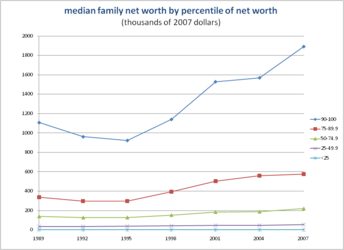
U.S. median family net worth by centile of sack valuable (1989–2007)
The total esteem of all U.S. household wealth in 2000 was approximately $44 one million million. Prior to the Late-2000s corne which began in December 2007 its value was at $65.9 trillion. After, it plunged to $48.5 trillion during the first quarter of 2009. The total household mesh valuable rose 1.3% by the quartern quarter of 2009 to $54.2 trillion, indicating the American economy is recovering.
| Folk meshing worth, by elite characteristics of families, 1989–2022 surveys[74] Thousands of 2022 dollars. Excluding net worth from pensions and Social Security. | ||||||||||||||||||
| Family characteristic | 1989 | 1992 | 1995 | 1998 | 2001 | 2004 | 2007 | 2010 | 2022 | |||||||||
| Median | Mean | Median | Bastardly | Median | Mean | Normal | Mean | Median | Mean | Median | Awful | Median | Mean | Median | Mean | Median | Mean | |
| Each families | 85.06 | 342.3 | 80.75 | 303.94 | 87.73 | 323.49 | 102.5 | 405.47 | 113.91 | 522.08 | 114.81 | 553.87 | 135.86 | 625.17 | 82.52 | 530.4 | 81.4 | 528.42 |
| Centile of income | ||||||||||||||||||
| Less than 20 | 3.47 | 44.64 | 6.4 | 54.14 | 9.05 | 67.76 | 8.25 | 70.85 | 10.37 | 70 | 9.15 | 88.24 | 9.87 | 118.86 | 6.49 | 125.24 | 6.2 | 87.53 |
| 20–39.9 | 44.83 | 123.03 | 45.09 | 105.32 | 52.67 | 121.87 | 49.46 | 139.66 | 50.61 | 155.16 | 42.38 | 151.95 | 42.44 | 151 | 29.69 | 139.27 | 21.5 | 111.35 |
| 40–59.9 | 76.13 | 185.52 | 64.26 | 164.79 | 69.52 | 154.09 | 76.26 | 179.75 | 83.7 | 214.46 | 89.34 | 241.35 | 99.26 | 236.53 | 69.59 | 211.24 | 61.8 | 170.07 |
| 60–79.9 | 122.01 | 246.89 | 122.52 | 227.02 | 114.45 | 242.5 | 159.68 | 291.76 | 185.95 | 387.54 | 197.3 | 418.27 | 229.84 | 417.51 | 136.21 | 313.35 | 158.71 | 333.84 |
| 80–89.9 | 242.45 | 404.26 | 194.76 | 370.36 | 194.74 | 392.56 | 270.18 | 471.22 | 344.46 | 594.93 | 387.21 | 607.97 | 401.4 | 689.52 | 309.65 | 610.39 | 298.4 | 629.92 |
| 90–100 | 713.99 | 1818.17 | 592.71 | 1565.69 | 542.04 | 1669.56 | 646.54 | 2218.94 | 1095.88 | 2968.97 | 1141.27 | 3130.45 | 1257.64 | 3712.54 | 1275.32 | 3114.95 | 1134.5 | 3248.01 |
| Age of head (years) | ||||||||||||||||||
| Inferior than 35 | 14.7 | 90.06 | 15.09 | 73.75 | 18.21 | 65.7 | 13.01 | 95.89 | 15.36 | 111.76 | 17.51 | 90.83 | 13.15 | 119.05 | 9.97 | 69.8 | 10.46 | 75.43 |
| 35–44 | 102.22 | 268.48 | 72.63 | 216.62 | 79.08 | 218.66 | 90.77 | 280.69 | 103.09 | 341.44 | 85.64 | 369.57 | 99.54 | 366.66 | 45.4 | 232.14 | 47.05 | 347.48 |
| 45–54 | 177.32 | 509.75 | 127.22 | 437.02 | 140.71 | 456.45 | 151 | 519.66 | 176.39 | 646.15 | 178.93 | 671.14 | 207.72 | 743.79 | 125.55 | 611.01 | 105.35 | 526.04 |
| 55–64 | 177.45 | 557.02 | 184.9 | 551.42 | 175.33 | 580.88 | 182.84 | 762.66 | 243.31 | 967.69 | 310.75 | 1044.82 | 284.85 | 1051.28 | 191.51 | 941.87 | 165.72 | 795.39 |
| 65–74 | 140.27 | 528.08 | 160.36 | 468.15 | 168.42 | 531.47 | 209.42 | 667.27 | 233.75 | 888.56 | 234.54 | 853.34 | 268.8 | 1137.84 | 221.49 | 902.95 | 232.1 | 1047.31 |
| 75 or more | 131.14 | 436.54 | 141.19 | 348.1 | 141.16 | 394.72 | 179.83 | 443.67 | 205.32 | 614.83 | 201.13 | 648.94 | 239.38 | 717.66 | 232.45 | 705.43 | 195 | 611.43 |
| Family bodily structure | ||||||||||||||||||
| Single with child(ren) | 12.65 | 114.8 | 13.78 | 86.21 | 18.21 | 110.45 | 23.02 | 149.95 | 17.12 | 125.04 | 25.4 | 161.14 | 27.77 | 200.2 | 16.77 | 153.45 | 14.16 | 129.14 |
| Single, no child, get on inferior than 55 | 14.91 | 135.53 | 24.37 | 114.93 | 26.35 | 110.23 | 22.16 | 131.31 | 25.61 | 196.09 | 26.64 | 192.92 | 28.18 | 233.42 | 15.75 | 126.72 | 14.14 | 148 |
| Undivided, no child, age 55 or more | 73.53 | 221.71 | 95.15 | 254.04 | 107.39 | 300.55 | 124.37 | 351.49 | 120.03 | 383.07 | 144.52 | 432.57 | 161.57 | 438.18 | 108.56 | 408.81 | 107.9 | 372.77 |
| Twain enceinte(ren) | 113.16 | 367.7 | 97.97 | 335.85 | 100.03 | 329.12 | 124.44 | 429.95 | 149.77 | 579.85 | 150.65 | 622.81 | 158.2 | 673.05 | 92.59 | 591.65 | 93.01 | 587.2 |
| Couple, no child | 202.41 | 644.02 | 167.97 | 513.01 | 175.77 | 551.23 | 212.24 | 689.38 | 230.8 | 846.48 | 257.23 | 928.84 | 251.39 | 1065.75 | 219.67 | 921.93 | 213.73 | 941.42 |
| Education of head | ||||||||||||||||||
| No up school sheepskin | 43.71 | 150.4 | 30.38 | 113.87 | 34.91 | 127.3 | 30.02 | 112.77 | 33.37 | 138.37 | 25.4 | 167.93 | 37.16 | 160.44 | 17.47 | 118.51 | 17.25 | 107.73 |
| High school diploma | 66.34 | 203.53 | 62.39 | 181.57 | 78.52 | 202.29 | 77.41 | 225.49 | 76.17 | 237.97 | 84.35 | 243.38 | 90.39 | 282.7 | 60.77 | 231.89 | 52.4 | 199.74 |
| Some college | 84.34 | 336.97 | 93.99 | 279.95 | 71.83 | 287.13 | 106.59 | 341.44 | 95.86 | 369.1 | 85.24 | 380.66 | 94.99 | 412.2 | 54.55 | 291.68 | 46.8 | 318.2 |
| College grade | 204.26 | 671.18 | 161.37 | 553.81 | 158.62 | 589.66 | 209.14 | 759.07 | 281.49 | 1050.7 | 279.45 | 1052.44 | 319.55 | 1233.48 | 207.37 | 1039.27 | 218.72 | 1015.52 |
| Race or ethnicity of respondent | ||||||||||||||||||
| Light non-Hispanic | 130.47 | 418.12 | 113.25 | 362.34 | 116.57 | 383.13 | 137.21 | 484.34 | 161.39 | 642.12 | 173.84 | 694.21 | 192.58 | 777.65 | 139.05 | 695.69 | 141.9 | 696.51 |
| Nonwhite or Hispanic | 11.37 | 117.06 | 19.5 | 126.01 | 23.53 | 117.04 | 23.73 | 143.6 | 23.66 | 154.39 | 30.64 | 189.1 | 31.66 | 257.55 | 21.97 | 188.11 | 18.1 | 184.23 |
| Incumbent work status of principal | ||||||||||||||||||
| Working for someone else | 69.23 | 207.12 | 64.26 | 199.6 | 75.14 | 209.04 | 74.91 | 241.89 | 85.88 | 299.38 | 83 | 332.93 | 105.09 | 394.83 | 59.05 | 319 | 62.09 | 314.78 |
| Freelance | 306.38 | 1201.18 | 238.84 | 977.15 | 236.94 | 1071.65 | 355.09 | 1320.2 | 459.63 | 1639.56 | 428.89 | 1755.61 | 436.77 | 2196.15 | 304.9 | 1842.66 | 359.5 | 2121.08 |
| Retired | 122.32 | 336.74 | 114.55 | 308.21 | 123.25 | 342.96 | 161.96 | 432.95 | 151.66 | 598.88 | 172.38 | 578.11 | 180.99 | 610.28 | 161.29 | 518.84 | 128.5 | 501.09 |
| Other not working | 1.05 | 84.2 | 5.36 | 86.31 | 5.53 | 86.56 | 5.15 | 154.2 | 10.24 | 234.05 | 14.37 | 199.98 | 6.4 | 138.74 | 12.75 | 144.38 | 9.06 | 135.15 |
| Current occupation of head | ||||||||||||||||||
| Managerial or professional | 202.05 | 693.66 | 165.37 | 613.03 | 168.17 | 660.62 | 189.84 | 778.16 | 260.15 | 1010.06 | 243.42 | 1066.24 | 277.56 | 1254.73 | 178.22 | 1110.19 | 192.6 | 1047.79 |
| Technical, gross revenue, or services | 50.49 | 236.17 | 59.47 | 223.19 | 56.09 | 242.98 | 59.04 | 275.56 | 60.8 | 259.47 | 55.94 | 305.19 | 82.95 | 348.41 | 34.85 | 234.04 | 31.66 | 267.59 |
| Other occupation | 66.81 | 201.6 | 53.24 | 142.14 | 69.37 | 171.55 | 71.19 | 179.84 | 65.21 | 179.04 | 70.07 | 182.02 | 72.7 | 215.72 | 49.92 | 174.08 | 49.24 | 172.31 |
| Retired or other not impermanent | 79.53 | 284.09 | 81.24 | 255.61 | 94.5 | 290.84 | 117.65 | 384.46 | 126.86 | 539.55 | 136.51 | 519.42 | 144.84 | 536.67 | 100.1 | 438.72 | 90.8 | 431.36 |
| Housing status | ||||||||||||||||||
| Owner | 181.82 | 492.75 | 161.01 | 439.95 | 157.63 | 463.61 | 188.98 | 580.49 | 226.79 | 736.75 | 227.76 | 772.14 | 263.8 | 874.29 | 185.41 | 758.71 | 195.5 | 773.41 |
| Renter or other | 3.62 | 76.29 | 5.28 | 62.9 | 7.32 | 66.6 | 6 | 61.82 | 6.33 | 72.39 | 4.99 | 66.83 | 5.73 | 80.01 | 5.47 | 60.79 | 5.4 | 70.39 |
| Percentile of meshing worth | ||||||||||||||||||
| Less than 25 | 0.2 | -0.98 | 0.81 | -0.91 | 1.44 | -0.23 | 0.71 | -2.64 | 1.58 | 0.1 | 2.1 | -1.64 | 1.47 | -2.36 | † | -13.01 | † | -12.97 |
| 25–49.9 | 37.96 | 41.84 | 38.31 | 41.38 | 42.99 | 46.49 | 46.95 | 51.42 | 53.84 | 58.39 | 53.76 | 58.16 | 60.87 | 65.27 | 34.62 | 38.19 | 31.36 | 35.86 |
| 50–74.9 | 157.8 | 162.17 | 142.82 | 147.45 | 144.38 | 151.23 | 172.63 | 183.98 | 207.36 | 219.86 | 210.99 | 229.18 | 247.68 | 255.71 | 168.04 | 180.14 | 168.23 | 177.71 |
| 75–89.9 | 382.57 | 411.6 | 332.1 | 355.92 | 336.53 | 362.35 | 444.48 | 461.3 | 566.59 | 594.04 | 628.78 | 652.2 | 642.46 | 660.23 | 514.33 | 562.65 | 505.08 | 546.25 |
| 90–100 | 1249.03 | 2294.4 | 1085.34 | 2035.37 | 1038.76 | 2196.97 | 1287 | 2779.65 | 1729.24 | 3631.65 | 1762.78 | 3845.83 | 2130.17 | 4462.99 | 1997.43 | 3945.86 | 1871.6 | 3962.43 |
| † Inferior than 0.05 ($50). | ||||||||||||||||||
Run into also [edit]
- Poverty in the The States
- Ethnic programs in the United States
- Wealthiness inequality in the United States
- Redistribution of wealth#Public_opinion
- States of the America of America by income
Wealth:
- Donor Course of instruction
- Irrational exuberance
- The Affluent Society
- Affluenza
Revenue enhancement dodging:
- Panama Papers
- Paradise Written document
General:
- Thriftiness of the United States
- Household income in the US
- International Ranking of Household Income
- List of Average Wages per Country
- Number of countries by sum wealth
- List of U.S. states by nest egg rate
References [edit]
- ^ Procter, Paul, ed. (1995). Cambridge International Dictionary of English. Cambridge: Cambridge University Press. ISBN0-521-48236-4.
- ^ a b "Household Income Percentile Calculator, US [2022]". DQYDJ. October 8, 2022. Retrieved November 16, 2022.
- ^ a b "Net Worth Percentile Calculator – U.S.A (and Average)". DQYDJ. Oct 2, 2022. Retrieved November 16, 2022.
- ^ "US Census Bureau, personal income distribution, 2005". Archived from the original on December 14, 2006. Retrieved December 11, 2006.
- ^ "The States Census 2005 Economic Sketch, income data". Archived from the original on June 30, 2006. Retrieved June 29, 2006.
- ^ a b Bruenig, Matt (March 24, 2022). "You call option this a meritocracy? Why rich inheritance is poisoning the American economy". Salon . Retrieved August 24, 2022.
- ^ a b Staff (Butt o 18, 2022). "Inequality – Inherited wealth". The Economist . Retrieved Aug 24, 2022.
- ^ a b Pizzigati, Sam (September 24, 2012). "The 'Self-Made' Delusion of America's Rich". Institute for Policy Studies . Retrieved August 24, 2022.
- ^ a b c d e f g h i j "US Nosecount Bureau, personal income distribution, age 25+, 2006". Archived from the original along March 19, 2007. Retrieved December 28, 2006.
- ^ a b "US Census Bureau, income statistical distribution of individuals, hired full-time, year round, age 25–64, 2006". Archived from the original on September 29, 2006. Retrieved December 27, 2006.
- ^ a b Ehrenreich, Barbara (1989). Fear of Down, The Inner Aliveness of the Bourgeoisie. New York, NY: Harpist Collins. ISBN0-06-097333-1.
- ^ a b c d e f Benjamin Thompson, William; Hickey, Joseph (2005). Society in Focus. Boston, MA: Pearson. ISBN0-205-41365-X.
- ^ a b c d "US Census Authority, income quintile and teetotum 5% household income distribution and demographic characteristics, 2006". Archived from the original on Jan 4, 2007. Retrieved December 28, 2006.
- ^ "Utilization Characteristics of Families Summary".
- ^ a b c d "US Census Bureau, overall household income distribution, 2006". Archived from the freehanded on January 4, 2007. Retrieved December 28, 2006.
- ^ a b "New York Times quote, households with incomes of concluded 1.6 million". Archived from the original on December 31, 2006. Retrieved December 28, 2006.
- ^ a b c d "Middle income pot't buy Middle division life style". Archived from the original on December 29, 2006. Retrieved December 28, 2006.
- ^ Rector, Robert E.; Johnson, Kirk A. (January 5, 2004). "Understanding Poverty in America". Archived from the original on Border district 13, 2010. Retrieved February 14, 2012.
- ^ Rector, Robert (August 27, 2007). "How Poor Are United States's Insufficient? Examining the "Plague" of Poverty in America". Archived from the original on March 12, 2010. Retrieved February 14, 2012.
- ^ a b c d e "US Federal Reserve on riches distribution in the United States" (PDF) . Retrieved July 12, 2006.
- ^ "America Is the Richest, and Just about Odds-on, Country".
- ^ a b "Americans' net worth upfield for 3rd unbent quarter". U.S. Federal Reserve. March 11, 2010. Archived from the original on Butt 13, 2010. Retrieved March 11, 2010.
- ^ a b c "Growing Wealth, Inequality, and Living accommodations in the The States." Zhu Xiao Di. Feb. 2007. Joint Shopping centre for Housing Studies.
- ^ "Wealthiness Inequality: Data and Models." Marco Cagetti and Mariacristina De Nardi. Aug. 2005. Federal Reserve Bank of Chicago.
- ^ "Households and Nonprofit Organizations; Net Charles Frederick Worth, Level". June 7, 2022.
- ^ a b Haskins, Daffo: "Wealth and Economic Mobility". Economic Mobility Project, 2007.
- ^ "Free exchange: The real wealth of nations". The Economist. June 30, 2012. Retrieved July 14, 2012.
- ^ "Comprehensive Wealthiness Report". IHDP. July 9, 2012. Archived from the original connected June 30, 2012. Retrieved July 14, 2012.
- ^ a b c "Income and poverty since 1967, US Census Bureau" (PDF) . Retrieved Sep 26, 2006.
- ^ a b "US Bureau of the Census, income quintilea and Top 5 Percent, 2004". Archived from the original on January 4, 2007. Retrieved December 27, 2006.
- ^ Dave Gilson and Carolyn Perot, "Information technology's the Inequality, Stupid", Mary Harris Jones, March/Apr 2011 Issue
- ^ WHO are the 1 percent?, CNN, October 29, 2011
- ^ a b "Tax Data Show Richest 1 Percent Took a Hit in 2008, Just Income Remained Extremely Single at the Top. Holocene epoch Gains of Bottom 90 Percent Wiped Out." Center on Budget and Insurance Priorities. Retrieved October 2011.
- ^ Robert Pear, "Top Earners Doubled Share of Carry Amelia Moore Nation's Income, Study Finds", The Recent York Times, October 25, 2011
- ^ Kertscher, Tom; Borowski, Greg (March 10, 2011). "The Truth-O-Beat Says: True – Michael Moore says 400 Americans have to a greater extent wealth than half of all Americans combined". PolitiFact. Retrieved Lordly 11, 2022.
- ^ Henry Spencer Moore, Michael (March 6, 2011). "United States of America Is Not Broke". HuffPost . Retrieved Venerable 11, 2022.
- ^ Thomas Moore, Michael (March 7, 2011). "The Forbes 400 vs. Everybody Else". michaelmoore.com. Archived from the original on Marchland 9, 2011. Retrieved August 28, 2022.
- ^ Pepitone, Julianne (September 22, 2010). "Forbes 400: The super-rich pay off richer". CNN. Retrieved Aug 11, 2022.
- ^ "Federal Reserve Board - Survey of Consumer Finances (SCF)". Board of Governors of the Federal Reserve System System of rules . Retrieved September 13, 2022.
- ^ "Wealth Inequality". Inequality.org . Retrieved September 13, 2022.
- ^ Costa, Pedro Nicolaci da. "U.S.A's Humongous Wealth Gap Is Widening Further". Forbes . Retrieved September 13, 2022.
- ^ "Decades of rise economic inequality in the U.S.: Testimony before the U.S. U.S. House of Representatives Ways and Means Committee". Economic Policy Institute . Retrieved September 13, 2022.
- ^ Plus reading on income mobility: http://research.stlouisfed.org/publications/es/11/ES1115.pdf
- ^ a b c Recent Trends in Household Wealth in the United States: Rising Debt and the Middle-Class Squeeze—an Update to 2007 by Edward N. Wolff, Impose Economics Constitute of Bard College, March 2010
- ^ a b Wealth, Income, and Powerfulness by G. William Domhoff of the UC-Santa Cruz Sociology Department
- ^ Pensions, Social Security, and the Distribution of Wealth by Arthur B. Kennickell and Annika E. Sundén of Board of Governors of the Federal Reserve System Arrangement
- ^ Broder, David (February 4, 2010). "Syndicated column:A sobering content. Budget show US connected 'unsustainable path'". Florida Nowadays. Melbourne, Florida. pp. 11A.
- ^ "US household net worth sets phonograph recording". Archived from the original on May 16, 2022. Retrieved July 28, 2022.
- ^ a b Eichar, Stephen A. Douglas (1989). Occupation and Class Cognisance in America. Westport, Connecticut River: Greenwood Press. ISBN0-313-26111-3.
- ^ a b "US Department of Parturiency, annual earnings for doctors". Archived from the original on December 28, 2006. Retrieved December 27, 2006.
- ^ "Salary.com". Archived from the original on February 6, 2009. Retrieved February 22, 2009.
- ^ "US DoL, CEO salaries". Archived from the original on December 22, 2006. Retrieved December 27, 2006.
- ^ a b c "Bureau of Labor statistics information publicized by Monster.com, 20 highest paying jobs". Archived from the original on Dec 27, 2006. Retrieved Dec 27, 2006.
- ^ "US Department of Drive, median income of Economists". Archived from the freehand connected December 28, 2006. Retrieved December 27, 2006.
- ^ "US Department of Labor, median income of Mathematicians". Archived from the freehanded on Dec 28, 2006. Retrieved December 27, 2006.
- ^ "United States Department of Labor, median income of business enterprise managers". Archived from the original connected December 16, 2006. Retrieved December 27, 2006.
- ^ "US Section of Labour, median income of Software Publishers". Archived from the innovative happening December 25, 2006. Retrieved December 27, 2006.
- ^ "US Census Agency, personal income for full-clock time, year round working made use of workers, age 25+". Archived from the original connected September 29, 2006. Retrieved December 28, 2006.
- ^ a b c "United States of America Census Bureau, household income distribution for Asians, 2006". Archived from the originative on September 29, 2006. Retrieved December 29, 2006.
- ^ a b c d "US Census Bureau, household income distribution for Whites". Archived from the original along Feb 18, 2007. Retrieved December 29, 2006.
- ^ "US Census Bureau, household income distribution for Whites, 2006". Archived from the freehanded on Sept 29, 2006. Retrieved December 29, 2006.
- ^ a b c "US Nose count Federal agency, household income distribution for Continent Americans". Archived from the original on September 29, 2006. Retrieved December 29, 2006.
- ^ a b c "US Census Bureau, household income distribution for Hispanics, 2006". Archived from the groundbreaking happening Sept 29, 2006. Retrieved December 29, 2006.
- ^ a b c "US Census Bureau, personal income dispersion for Asian Americans, 2006". Archived from the original on September 29, 2006. Retrieved December 29, 2006.
- ^ a b c "US Nosecount Bureau, personal income distribution for Whites, 2006". Archived from the original on September 29, 2006. Retrieved December 29, 2006.
- ^ a b c "US Nose count Bureau, personal income distribution for Hispanics, 2006". Archived from the original connected September 29, 2006. Retrieved Dec 29, 2006.
- ^ a b c "US Census Bureau, in the flesh income distribution for African Americans, 2006". Archived from the freehanded connected May 9, 2011. Retrieved December 29, 2006.
- ^ "US Census Agency, overall households income dispersion to $100,000, 2006". Archived from the originative on December 30, 2006. Retrieved December 29, 2006.
- ^ "United States of America Census Bureau, Personal income, age 25+, 2006 statistics forum". Archived from the original along January 4, 2007. Retrieved December 17, 2006.
- ^ a b c Levine, Rhonda (1998). Social Class and Stratification. Lanham, MD: Rowman & Littlefield. ISBN0-8476-8543-8.
- ^ "United States Department of Labor, median income of listed nurses". Archived from the innovational happening January 2, 2007. Retrieved January 2, 2007.
- ^ "The New York Multiplication, Richest Are Leaving Even the Ample Far Behind". June 5, 2005. Retrieved January 2, 2007.
- ^ Krugman, Paul (Sep 28, 2022). "Our Invisible Rich". The Unaccustomed York Times . Retrieved October 1, 2022.
- ^ Sum-up Results, Public Date, Estimates inflation-adjusted to 2022 dollars, Table 4
Further reading [edit]
- Frank, Robert L. (2007). Richistan: A Journey Through the American Wealth Boom out and the Lives of the New Rich . Poll Publishing Group. pp. 277. ISBN978-0-307-33926-3.
External links [edit]
- Alternate income measures forum.
- Americans Underestimate U.S. Wealth Inequality (sound – NPR).
- 15 Mind-Blowing Facts Some Wealth And Inequality In U.S. (charts – The Business Insider).
- Information technology's the Inequality, Stupid: 11 Charts that Explain Everything that's Wrong with America (Mother Jones – March 2011).
- US Census Bureau, personal income forum.
- The States Nosecount Bureau, household income forum.
- "Wealth Gap" – A Manoeuvre (AP Intelligence – January 2022).
- Introducing the Distributional Business enterprise Accounts of the Federated States (Fed – March 2022)
How Much Money Do You Have To Make To Be In The Top 1%
Source: https://en.wikipedia.org/wiki/Affluence_in_the_United_States
Posted by: godwindrome1960.blogspot.com
0 Response to "How Much Money Do You Have To Make To Be In The Top 1%"
Post a Comment